
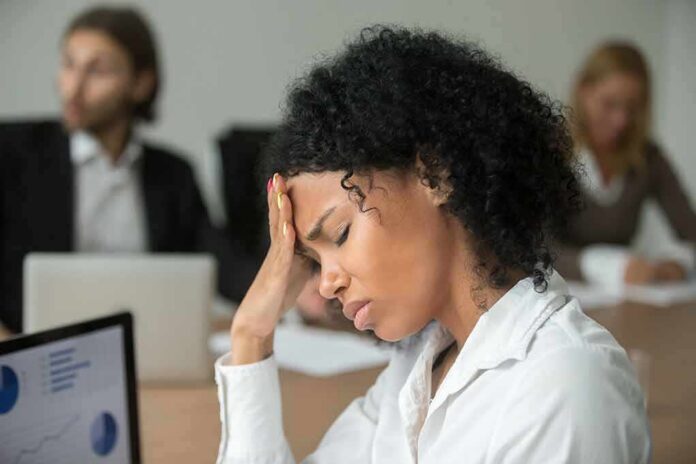
Women are three times more likely than men to suffer from migraines, and the reason traces back to hormones most people never think about.
Story Snapshot
- CTV News aired a segment on August 17, 2026, with neurologist Dr. Vanessa Doyle explaining why migraines hit women harder.
- Global health data shows migraine affects roughly 20.7% of women compared to 9.7% of men.
- Hormonal shifts tied to periods, pregnancy, and menopause play a major role in when and how badly migraines strike.
- There is no cure yet, but doctors now have better tools to prevent and treat attacks.
What Makes a Migraine Different From a Headache
A migraine is not just a bad headache. It is a neurological disorder that causes throbbing pain, usually on one side of the head, lasting anywhere from four hours to three full days. Attacks often bring nausea, vomiting, and painful sensitivity to light and sound. For many women, this means missed workdays, canceled plans, and hours spent in a dark room waiting for the pain to pass.
Dr. Doyle’s appearance on CTV News framed migraine as “a commonly dismissed medical condition that disproportionately impacts the lives of women”. That framing matters. Millions of women have been told to push through the pain or blame stress alone, when the real driver often runs deeper, in the body’s hormonal chemistry.
Why Women Bear the Bigger Burden
Before puberty, boys and girls get migraines at similar rates. After puberty, the gap widens fast, with migraine becoming three to four times more common in women. Researchers point to estrogen, a hormone that swings sharply during the menstrual cycle, pregnancy, and menopause, as a key trigger. Women also tend to report longer, more disabling attacks than men do.
The numbers are striking on their own. One large national health survey found migraine affects about one in five women over a three-month period, compared to under one in ten men. Nearly a third of women with migraines link their attacks directly to their menstrual cycle, and that share climbs to over half among women who have not yet reached menopause.
Hormones Drive the Pattern Across a Lifetime
Migraine often starts around the time a girl gets her first period and continues through her childbearing years, when hormone levels shift the most. Pregnancy can bring relief for some women, especially in the second and third trimesters, while others see no change or worsening symptoms. Menopause brings its own turbulence, as falling and fluctuating estrogen levels can trigger fresh waves of attacks even in women who had never struggled with migraines before.
Doctors describe this as the “estrogen withdrawal theory.” A sudden drop in estrogen, not just low estrogen itself, appears to set off many attacks. That is why migraines often cluster right before a period starts, when estrogen levels fall fastest. Understanding this pattern helps explain why standard headache advice, like drink more water or reduce screen time, does not always work for women whose migraines are hormonally driven.
Treatment Options and What Doctors Want Women to Ask
There is still no outright cure for migraine, but treatment has improved. A Montreal neurologist put it plainly: “There is currently no cure for migraine; its treatment is symptomatic, and we are now beginning to see new preventive treatments”. Newer preventive medications target the specific proteins involved in migraine attacks, offering relief that older drugs could not.
Health experts encourage women to track their symptoms alongside their menstrual cycle, since patterns often reveal whether hormones are a trigger. Doctors also stress that migraine is a genetic, biological condition, not a personal failing or a sign of weakness. Women dealing with pregnancy, birth control, or menopause should talk with their doctor before starting or changing any migraine treatment, since hormone-based therapies carry their own risks and benefits depending on age and health history.
The Bottom Line
Migraine research keeps confirming what many women already suspected from lived experience: this condition is not evenly distributed, and hormones are a major reason why. Public awareness pieces like the CTV segment help push back against decades of dismissiveness toward women’s pain. Taking migraine seriously as a hormone-linked medical condition, rather than an inconvenience to tolerate, is a common-sense step toward better care for millions of women.
Sources:
youtube.com, ctvnews.ca, theconversation.com, americanmigrainefoundation.org, womenshealth.gov, npr.org, jeanhailes.org.au, pubmed.ncbi.nlm.nih.gov