
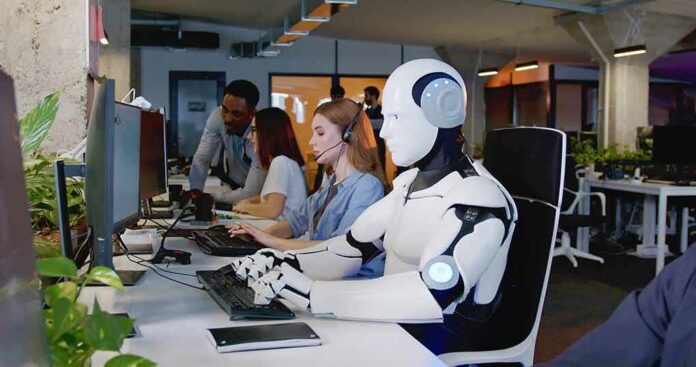
AI can now write your emails, crunch your numbers, and even mimic a caring tone in a chat window, but it still cannot sit with a grieving employee or earn a coworker’s trust the way a person can.
Quick Take
- A widely read Time essay argues AI will reshape how people work but cannot replace human relationships, empathy, or judgment
- Researchers find AI empathy can boost comfort in simple tasks but loses trust in emotionally loaded situations
- Labor economists say automation replaces specific tasks, not the human traits that require trust and judgment under pressure
- Experts warn synthetic companionship may ease loneliness short-term but can deepen isolation over time
What The Original Argument Actually Says
The Time essay published in September lays out a simple but firm claim. AI will change how people do their jobs, but it cannot replace the human bond behind good work. The author writes that AI “can’t demonstrate genuine empathy, navigate difficult conversations, inspire confidence, or build lasting relationships”. That is the heart of the piece, and it holds up against a mountain of research.
The essay gives real examples. AI cannot sit across the table from a family deciding whether to move for a job. It cannot coach a struggling employee through a rough patch or read tension in a room during a tough meeting. Those moments require a human presence, not a script generated by a machine, no matter how well the machine mimics warmth.
Why The Research Backs This Up
A systematic review of fifty studies on emotional AI found the technology can boost cooperation and even well-being in some settings. But the same review flagged real concerns about privacy, bias, and manipulation baked into these systems. Comfort is not the same as care, and users seem to sense the difference even when they cannot name it.
Other researchers found something even more telling. Artificial empathy raises trust and usefulness in functional tasks, like filing a claim or booking an appointment. But those same positive effects shrink sharply in emotional situations, the moments that matter most to people. The pattern is consistent: machines help with logistics, not with the heart.
The Labor Economics Angle Matters Too
Decades of labor research show automation displaces tasks, not people in full. Machines take over narrow, repeatable jobs while new tasks emerge that still need a human touch. This framework explains why AI keeps expanding into scheduling, data entry, and drafting, yet keeps failing to take over roles built on trust, judgment, and human connection.
A frontier psychology paper puts a sharp label on the gap. Researchers call it the “compassion illusion,” meaning AI can imitate the expression of empathy but not the experience of it. It lacks intention, a body, and moral stakes. That is not a small technical gap. It is the entire difference between simulation and something real.
What Happens When People Lean On AI For Connection
Some people already trust chatbots with their feelings more than they trust coworkers, doctors, or even elected officials. That is a striking shift, and it shows how fast AI has moved into emotional territory once reserved for humans. But trust in a machine is not the same as being truly known by another person.
A New York Times opinion piece warns that a flood of synthetic support can quietly distort real relationships, making people feel more isolated even as machines promise connection. The American Psychological Association’s own trend report echoes this. Synthetic companions may ease loneliness briefly, but heavy use risks worsening isolation and weakening social skills over time.
The Bottom Line For Workers And Leaders
None of this means AI is useless at work. Far from it. Companies that use AI wisely gain speed, accuracy, and scale on repetitive tasks. But the traits that make a workplace function, trust between coworkers, honest feedback, and steady leadership during hard times, still come from people, not code. That is common sense, not a controversial take.
Business leaders chasing efficiency should remember what the data already shows. Machines can extend human capability. They cannot replace the human being doing the extending. Any workplace strategy that forgets this trades short-term savings for long-term damage to the very relationships that keep teams, and companies, together.
Sources:
time.com, nytimes.com, brookings.edu, birkman.com, leonecentre.com, eu-opensci.org, discovery.researcher.life, aeaweb.org, sciencedirect.com