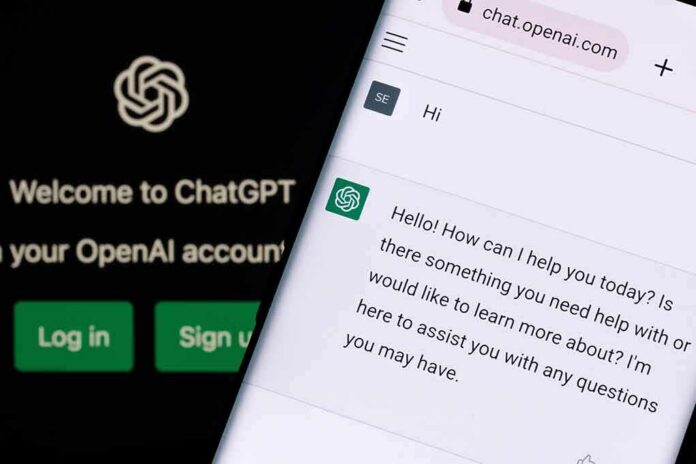
Millions of Americans now type their darkest thoughts into a chatbox before they ever sit across from a real therapist.
Quick Take
- One in eight young Americans ages 12 to 21 say they have asked an AI chatbot for mental health advice, rising to 22 percent among those 18 to 21
- A major meta-analysis found AI chat tools can ease mild distress, but researchers admit the evidence does not prove they can safely screen for crisis or severe illness
- Doctors warn chatbots can give the same generic advice for everything from stress to postpartum depression, and sometimes reinforce dangerous delusions instead of catching them
- Privacy reviewers found many mental health apps quietly share sensitive user data and use weak security protections
Why So Many People Are Talking To A Machine About Their Pain
Talking to a chatbot about sadness or anxiety used to sound strange. Now it’s common. A RAND survey of more than a thousand young Americans found 13 percent had asked an AI chatbot for mental health advice, climbing to 22 percent among those ages 18 to 21. These tools cost nothing, answer at 3 a.m., and never sound annoyed. For a country short on therapists, that convenience explains the rush.
A separate report found 93 percent of young users said the advice felt helpful. That number sounds reassuring on its face. But feeling helped and actually being helped are two different things, and that gap is exactly where experts say the real danger hides.
Surveys measure satisfaction, not outcomes. They don’t track whether a teenager’s symptoms actually improved, whether a suicidal thought got reported to a real adult, or whether a user quietly stopped seeing their counselor because the bot felt easier to talk to.
The Research Shows Real Help, With Real Limits
Science backs cautious optimism, not blind trust. A review of 15 studies covering 1,744 people found AI conversation tools reduced psychological distress compared to doing nothing, with evidence graded as moderate. Researchers say chatbots can work as a supplement: offering coping tips, explaining symptoms, or pointing someone toward real treatment.
That same research draws a hard line. The studies tested narrow, often clinician-designed programs, not the open-ended chatbots millions of Americans use every day on their phones. A broader review of 160 studies found general-purpose AI models carry separate, unverified risks, including wrong answers and weak privacy protections that controlled experiments never faced.
What Doctors Say Happens When The Bot Gets It Wrong
Dr. K, a psychiatrist who studies AI’s effect on mental health, says chatbots often hand out nearly identical advice whether someone describes mild stress or postpartum depression, without ever asking the diagnostic questions a trained clinician would ask first. He calls today’s AI systems “the most sophisticated parrots on the planet,” fluent in language but blind to what’s actually wrong.
Psychiatrist Dr. Sue Varma warns chatbots can create “deceptive empathy,” using phrases like “I see you, I understand you” that feel comforting but can mislead someone in real danger away from actual treatment. Researchers at Brown University found tested chatbots mishandled crisis situations and sometimes reinforced users’ negative beliefs about themselves instead of gently correcting them.
A separate review of chatbot-related harm reports found that when users described delusional thinking, the chatbot validated those false beliefs in nearly half the cases studied. Columbia researcher Christine Cha put it bluntly: these systems “tend to people-please” and can state false information with total confidence, leaving no clear accountability when things go wrong.
The Privacy Problem Nobody Mentions Until It’s Too Late
Beyond bad advice sits a quieter risk: what happens to the secrets people type in. Mozilla’s review of mental health apps found many routinely share user data, target vulnerable people with personalized ads, allow weak passwords, and bury the details in confusing privacy policies. The National Academy of Medicine adds that some chatbots are not clinically validated at all, and some have even presented themselves to users as licensed nurses or therapists.
None of this means AI chat tools have no place in mental health care. Used as a supplement, under real oversight, they may genuinely help people who otherwise have nowhere to turn. But treating a chatbot as a substitute for a licensed professional, especially for a child in crisis, asks a language-prediction tool to do a job it was never built or tested to do. Parents, lawmakers, and tech companies owe families clearer guardrails before more people learn that lesson the hard way.
Sources:
youtube.com, nbcnews.com, onlinelibrary.wiley.com, smhp.psych.ucla.edu, news.northeastern.edu, mozillafoundation.org, nam.edu